Explore how Bloomberg Tax Provision’s new rate rec automatically adapts to ASU 2023-09 to simplify reporting compliance.
Comparing Tax Provision Software: A Buyer’s Guide to Tax Provision Automation
Choosing the right tax provision software starts with naming your pain points and then evaluating each solution against how it handles rate reconciliation, internal controls, audit support, flexibility, and implementation speed. The best fit automates ASC 740 calculations, keeps your rate reconciliation tied out from the start, and scales as your business grows.
Navigating the intricate maze of the corporate tax provision process is complicated. With tight timelines and magnified scrutiny, it’s a walk on a tightrope, where every misstep could mean inaccuracies and potential control failures. Many companies kick off their tax provision calculations in Excel. After all, it’s familiar territory. Excel spreadsheets offer flexibility, and building out the basic calculations is easy.
However, that same flexibility can create risk in the form of incorrect formulas, version control issues, and other spreadsheet deficiencies. Excel also doesn’t easily adapt to the common factors that complicate the provision process, such as adding new jurisdictions or legal entities, making last-minute changes, or incorporating tax law changes.
It’s often these factors that motivate tax departments to make major changes to their provision process, including making the switch to a new tax automation software solution. Or perhaps new leadership or a new audit team precipitates the need for a better process.
But even in times of relative stability, certain challenges remain – and are only getting worse. Close times are shorter, reporting requirements are increasing, and accuracy remains critical.
Bloomberg Tax surveyed 600 provision professionals and found that companies of all sizes could benefit from rethinking their current process and tools.
Why Excel falls short for the tax provision
Excel is a great tool, but it wasn’t built for the realities of ASC 740. The slightest data entry error, omission, or inconsistency can produce an inaccurate calculation or send you combing through complex spreadsheets for hours to find the problem.
As your business scales and tax scenarios get more complex, manual methods become error-prone and inefficient. Consider what the survey data revealed about one of the most important schedules in the entire process.
When asked about their use of rate reconciliation comparison schedules for review and analysis, only 25% of professionals said their provision software generates those schedules. That means the remaining 75% either don’t prepare them at all or build them manually, likely in Excel.
Yet when we asked which parts of the provision process management cares about the most, the top two responses were:
- The rate reconciliation (31%)
- Accuracy of the process/no control issues (27%)
In other words, the two areas of the provision process management recognizes as most important are the exact areas where manual processes fall short. Just because something is important doesn’t mean it has to be difficult and time-consuming. The right provision automation software can make your job easier and reduce the risks that keep you up at night.
Bloomberg Tax Provision vs. Alternatives
[Download our Buyer’s Guide to Tax Provision Software for a practical playbook designed to help tax leaders choose the best provision software for their needs.]
Common provision challenges
Precision, compliance, and efficiency are paramount to completing your tax provision. Any weak spots in the process can lead to expensive financial restatements, scrutiny from auditors and regulators, and reputational damage.
When asked which areas create the most challenges for the provision process, the top two responses in our survey were:
- Data gathering, transformation, and manipulation (32%)
- Tax technical complexity, i.e. applying the tax law to your data (20%)
The four most common challenges that provision professionals say can impede a smooth provision process are:
- Data challenges. Pulling, cleaning, and reconciling data from multiple systems eats up time and invites error.
- Technical complexity. Applying evolving tax law correctly takes deep expertise and that expertise is hard to scale.
- Reliance on manual processes. Manual steps slow you down and introduce risk.
- Lack of flexibility and transparency. Rigid tools can’t keep up with new jurisdictions, entities, or last-minute changes, and they make it hard to trace where numbers come from.
If these challenges sound familiar, it’s time to reflect on whether your current approach – be it Excel or another software solution – is truly serving your needs. Embracing a solution specifically designed around the nuances of ASC 740 and the inherent challenges of the tax provision landscape is more than just a good idea – it’s a strategic imperative.
[Ready to start your journey toward choosing and implementing a provision software solution? Download our complete buyer’s guide.]
Evaluating tax provision software: 7 questions to ask
Tax provision software is a specialized digital solution designed to handle complex tax provision calculations and comply with the most up-to-date laws and regulations.
Traditionally, many organizations relied on Excel to carry out complex ASC 740 tax provision calculations. While Excel is a great tool, it has limitations. The slightest data entry error, omission, or inconsistency can result in inaccurate calculations – or hours spent combing through complex spreadsheets to find the problem.
With the right tool, you don’t have to rely on manual methods that become error-prone and inefficient as your business scales and tax scenarios become more complicated. It meets the needs of busy tax professionals by providing a streamlined, accurate, and efficient tool to navigate the journey from tax calculation to compliance.
But how do you choose a tax provision software? First, identify your tax provision pain points. Before diving into software comparisons, list your key needs and challenges. What issues do you frequently encounter? What features are absolute must-haves for your organization?
Ask these questions about the software you’re comparing
- How does it handle the rate reconciliation?
- How does it support internal controls?
- Does it provide audit-ready support?
- Is it flexible enough to fit your evolving needs?
- Does it offer an intuitive user interface?
- How easily can you roll forward from one period to the next?
- How quickly can you implement it?
9 must-have features in your provision solution
When comparing tax provision software, these nine key capabilities will help you make an informed choice about the best tax software for your needs. These powerful features will benefit not only your tax team, but your entire organization.
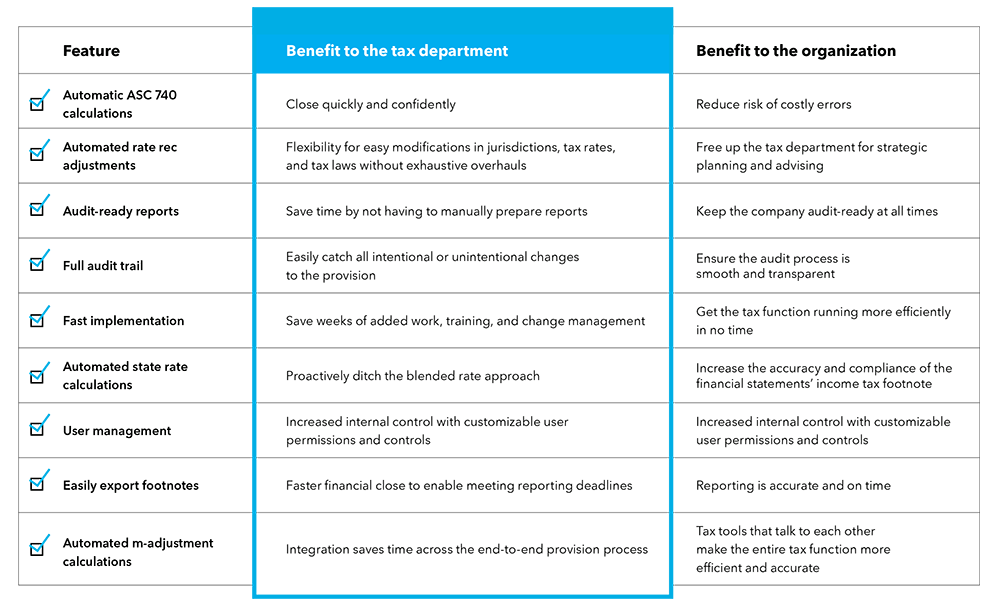
Click image to zoom
Build the business case for tax provision software
Once you’ve identified the best solution, you’ll likely have to make the case to your tax department leadership or the C-suite. Build a strong business case for why your organization needs to invest in the tax provision solution by being honest about your pain points and the potential costs of inaction.
In most organizations, the tax provision is the only element of the financial statement that hasn’t seen significant investment. However, continuous changes to the tax laws and regulations affecting your provision indicate that this is an area of external focus – and should be a focus for your organization.
Elements of a compelling business case for investing in tax technology
Follow the steps below to present a clear, results-driven business case to your stakeholders for finally modernizing and automating your provision process:
- Identify and quantify the challenges of current methods.
- Acknowledge the risks of key-person dependency and emphasize the need for a repeatable, automated process that doesn’t rely on a single point of institutional knowledge.
- Highlight the hours spent on manual data entry and verification.
- Put a tangible figure on the cost of these hours – not just in salaries but in the opportunity cost of tasks your team could tackle if freed from laborious spreadsheet management.
- Combine these arguments with the potential financial penalties or reputational damage from incorrect filings, and you present a clear financial and operational case for the shift.
- Address scalability concerns. As the company grows or enters new markets, Excel’s limitations become even more pronounced. Compare this to the automated, standardized processes in tax provision software, which can seamlessly adapt to more complex tax scenarios.
- Stress the importance of compliance and auditability. Dedicated software provides a built-in audit trail and automatically delivers audit-ready reports.
Making the case for the company to invest in new technology can be an unfamiliar (and often daunting) exercise for the tax department. Set yourself up for success with our complete Buyer’s Guide to Tax Provision Software.
Elevate your ASC 740 process with Bloomberg Tax Provision
Switching to tax provision software can understandably give some companies cold feet, especially since there are a lot of tax automation solutions on the market that overpromise and underdeliver. However, Bloomberg Tax Provision isn’t just another software – it’s the tool that automates complex calculations for accurate provision that always tie out. Here’s what makes it different.
Easy implementation, no code required
Bloomberg Tax Provision is built for tax professionals, not software administrators. The platform speaks ASC 740 natively and fits your existing process. There’s no coding, mapping, or translating your workflow into software-specific terminology. If you know how to run a provision, you already know how to use it. Implementation and onboarding take weeks, not months, so your team gets operational fast and without added headcount.
Connected to an AI-powered tax suite
Bloomberg Tax Provision doesn’t work in isolation. It’s part of an AI-enabled tax suite, connecting to Research, Workpapers, and Fixed Assets so your data flows through one seamless workflow. Through a smart integration with Bloomberg Tax Research, the latest tax rates automatically update and flow directly into your provision. As one Fortune 500 tax director put it, “I think it’s super cool that it allows you to update the tax rates in the tax provision software from the tax research module.” When your tax process works as one, complexity becomes manageable and redundancies disappear.
Audit-ready reports with built-in formulas
Bloomberg Tax Provision delivers strong review and audit support with Excel reports that include formulas, something many competitors don’t offer. Every number is traceable, and a complete audit trail records who changed what, and when, throughout the life of the provision. That traceability turns audit season from a scramble into a straightforward review.
A rate rec that always ties
The rate reconciliation is management’s top priority – and Bloomberg Tax Provision treats it that way. The software runs ASC 740 calculations automatically and applies adjustments across your rate rec and all related schedules, so they’re guaranteed to tie out. Your numbers don’t just balance at the end; they stay tied out throughout the process.
Built to evolve as you grow
Built around an integrated data model, Bloomberg Tax Provision adapts to new business facts as they arise. When facts are added or updated, the relevant impacts flow across your provision calculation automatically. With support for as many filing groups, legal entities, and jurisdictions as you need – plus unlimited tax attributes – the solution scales right alongside your business. There’s no need to rebuild your process every time the company grows.
Make your next provision your easiest yet
The corporate tax provision will always demand precision. But it doesn’t have to demand late nights, brittle spreadsheets, and last-minute scrambles. By naming your pain points, evaluating software against the right questions, and building a clear business case, you can modernize your process with confidence.
Request a demo to see how Bloomberg Tax Provision software automates calculations across the entire tax provision lifecycle and applies adjustments, so they’re guaranteed to tie out – all within a clean design that feels intuitive to use.