How a Fortune 500 Company Simplified Hundreds of State Calculations With Bloomberg Tax Provision
A Fortune 500 provider of electrical and mechanical services for commercial real estate faced pressures on two fronts: addressing state tax filings across more than 120 entities and complying with their auditor’s mandate to shift from a blended deferred state tax rate to state-by-state calculations. These demands strained the company’s lean 10-person corporate tax department, which had relied on Excel for more than 30 years.
After more than a year mired in a complicated – and ultimately unsuccessful – implementation of the leading provision software provider, the tax director turned to Bloomberg Tax Provision, a platform built for ASC 740 and designed to incorporate new FASB updates to income tax reporting.
Despite the sunk cost in the prior system, the pivot to Bloomberg Tax Provision quickly paid off.
Key outcomes:
- Standardized state tax calculations, easing the management of roughly five acquisitions per year
- Gained traceable, audit-ready reports
- Freed team capacity away from manual cross-checks toward higher-value analysis
Challenge: Volume of state filings outpaces existing tools
The tax department encountered significant challenges as its multi-state operations outpaced the capabilities of its existing tools. When manual processes in Excel became unmanageable, the tax director turned to a familiar software solution, but it ultimately failed to meet the team’s needs.
These issues led to inefficiencies, bottlenecks, and heightened pressure during quarterly and year-end close processes.
Multi-state growth overwhelms Excel
With a tendency for four to five acquisitions a year, the company’s rapid growth put a strain on its tax team.
“Every time we acquire another company, everything grows exponentially,” said the tax director. “When an entity qualifies to do business in one additional state, that results in six new calculations, which all need to be set up in Excel and the formulas need to be created and checked and linked to the supporting information.”
What once felt manageable now became unwieldy, with 120 operating entities and around 500 state returns to file.
“To do that in Excel, while theoretically possible, is enormous and led to additional risk in the process due to file size,” the tax director said, noting issues like overriding formulas and broken links.
‘Trusted’ software with limited capabilities
Faced with Excel’s constraints, and hoping to standardize the provision process, the tax director turned to software she’d used before.
She hoped it would offer synergies between its compliance and provision platforms, however the system fell short of expectations. Instead of streamlining the process, the software introduced inefficiencies.
For example, taxable income was entered into the software, exported to Excel for NOL adjustments and state tax expense, then re-imported.
“It’s a recipe for disaster with so many state returns,” the tax lead said.
Among additional limitations, the software’s output reports – presented as static numbers without formulas – eliminated traceability and further undermined efficiency.
A year into the implementation, the company’s tax leadership was so disappointed with the results that they were willing to pivot to an entirely new provider.
“I was majorly frustrated,” the tax director said. “It wasn’t even like I felt like, OK, I put in a year of work, I have something to show for it. It still was not doing what I needed it to do.”
Pinch-points peak at quarter and year-end
The tax team calculates the tax provision every month for internal reporting, but the quarter and year-end endure the heightened pressure of condensed timelines and auditor scrutiny.
About a week after quarter-end, the department receives book numbers. Corporate finance then has a week to review subsidiary inputs and post top-side adjustments. The tax team then assembles consolidated provision entries, auditor documentation, and financial statement footnotes.
But inefficiencies with Excel – and then the legacy software they initially chose – slowed every step.
Solution: Faster processes, audit-ready reports, and FASB compliance – after an easy one-month implementation
As a happy customer of Bloomberg Tax’s research and fixed assets products, the tax director was excited to learn more about Bloomberg Tax’s provision offering when it entered the market in 2021.
“I was immediately impressed that it seemed so easy to use and comprehensive – and able to do state calculations, which was a big, big plus,” the tax director said.
With a user-friendly design, comprehensive capabilities, and painless implementation, the software addressed the company’s pain points directly.
“The implementation was super easy, super quick,” said the tax director, highlighting Bloomberg Tax Provision’s intuitive interface that “looks like what a tax accountant would design.”
Quick implementation time leads to immediate results
From beginning to end, the implementation took just one month.
The process comprised a weekly one-hour call with an implementation lead, who would walk through the setup on screen, then assign steps to the company’s tax operations. At each stage, the implementation specialist solicited questions, which were addressed before moving on.
By the end of four weeks, the system was fully in place – a clear winner compared to the other provider.
As the tax director put it: “A year and nothing versus a month and satisfaction with Bloomberg Tax.”
To build confidence with the company’s CFO and auditors, the tax director ran Bloomberg Tax Provision in parallel with Excel for about a year, including a full year-end close.
The results matched the company’s spreadsheets, giving leadership the confidence to retire the Excel-driven process. Today, the department relies exclusively on Bloomberg Tax Provision.
Automated calculations enhance accuracy and confidence
The built-in formulas and automated processes ensure accurate calculations, eliminating the risks of human mistakes inherent in Excel or less advanced software.
“I can be so much more confident in my calculations,” said the tax director. “I don’t have to worry that I built the formula the right way.”
Calculations flow automatically across schedules, eliminating the need to verify every link.
For example, when a net operating loss is generated or utilized in a current calculation, the system automatically updates the deferred rollforward to reflect it – “that’s incredible,” the tax director said.
As the tax director noted, qualifying in one new state can trigger numerous new calculations.
Now with one click, those calculations are automated – the current calculation, every deferred rollforward column, and payable entries. The result is reliability, without the risk of state omissions.
Time reclaimed for analysis
With Bloomberg Tax Provision’s time-saving automations in place, the team can devote greater focus to interpreting results.
“We are at a place where our process has become second nature,” the tax director said. “That allows us to spend the time looking at the results and think, ‘Why did these numbers change?’”
This proactive shift also strengthens the department’s relevance.
“That’s allowing me to come up with answers that the auditors – and my boss – are going to need without having to build something, figure it out, or dig through a bunch of reports,” the tax director said.
[See how you can standardize calculations and unlock strategic insights with Bloomberg Tax Provision. Request a demo.]
Audit-ready reports and transparency streamline reviews
The switch to Bloomberg Tax Provision has streamlined audits and quicker resolution of year-end reporting. Before, auditors faced a “tremendous file” that took time to be checked and tied.
“Now, we can export reports when we’re done, and auditors can trace exactly how the numbers are calculated,” the tax director said. “It’s like a miracle.”
Comparison reports deepen this transparency by allowing the user to line up one month or quarter against the last and easily trace differences back to a specific entity or return.
“It’s giving me that information, so I can have those explanations ready,” rather than piecing together data from multiple spreadsheets.
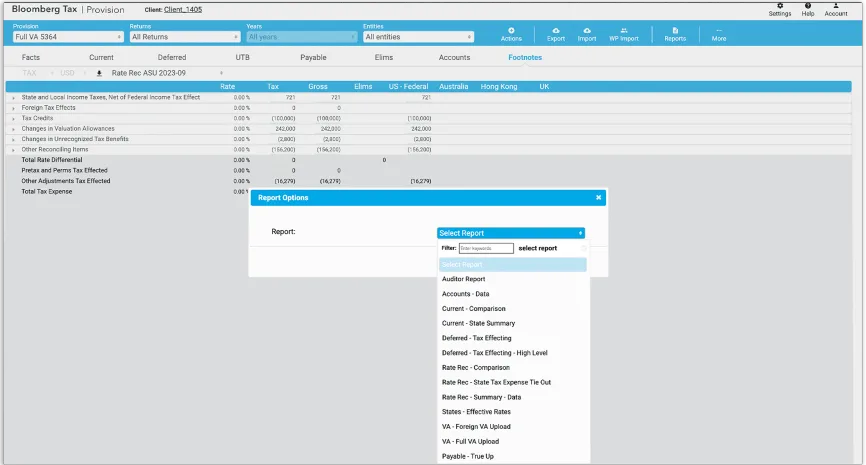
Bloomberg Tax Provision reports show simple math, allowing for easy review, traceability, and auditability.
Comprehensive state tax capabilities save hours of time
Another important feature is the software’s ability to apply percentage limitations for NOLs – “fantastically helpful,” the tax director said.
Unlike systems that rely on blended state rates, Bloomberg Tax Provision calculates jurisdiction-specific percentage limits, all aligned with the new ASU 2023-09 disclosure requirements.
This saves hours of manual calculation for each return, particularly for companies filing in multiple jurisdictions.
Integration with Bloomberg Tax Research
Thanks to a smart integration with Bloomberg Tax Research, the provision software automatically update tax rates, seamlessly flowing into your provision.
Having relied on Bloomberg Tax’s trusted Tax Management Portfolios throughout her career, the tax director appreciates the “real world language” of the explanations.
“When I have to research something, I use Bloomberg Tax Research,” she said. “I think it’s super cool that it allows you to update the tax rates in the tax provision software from the tax research module.”
[Learn more about how our integrated tax tools make your work less complicated so you can streamline processes, mitigate risk, and focus on long-term tax strategy.]
Bloomberg Tax Provision vs. Alternatives
Why switching to Bloomberg Tax was the right decision
Bloomberg Tax Provision is a cloud-based solution that automates your ASC 740 calculations, delivering more accurate income tax reporting and smoother audits. Built for tax professionals, not software administrators, the platform speaks ASC 740 natively and fits the way you already work. If you know how to run a provision, you already know how to use it. There’s no coding, no mapping, and no translating your process into software-specific terminology. With implementation and onboarding completed in weeks rather than months, your team can be up and running faster than ever.
As part of an AI-enabled tax suite, Bloomberg Tax Provision helps your team automate workflows and scale operations with confidence. It connects to powerful tools, including Research, Workpapers, and Fixed Assets, so your data flows through one seamless workflow. You get AI-enabled tax research and guidance, grounded in deep tax expertise, right where you work, helping you move faster and deliver greater accuracy.
The results speak for themselves. Though one tax director was initially hesitant to abandon her legacy software implementation after so much time and effort, she now reflects, “I am so glad that we made that decision.”
Request a demo to see how Bloomberg Tax Provision automates calculations across the tax provision lifecycle and applies adjustments that always tie out.