How to Save 90 Hours on Tax Reconciliation Processes With Bloomberg Tax Workpapers
A global aluminum and energy company with operations spanning North America, Europe, South America, and Asia struggled to manage a complex operational footprint supported by multiple enterprise resource planning (ERP) systems.
To streamline tax workflows, improve data accuracy, and reduce reliance on manual Excel-based processes, the company turned to Bloomberg Tax Workpapers.
Results include:
- Automated processes cut tax reconciliation time from 8 hours to 30 minutes, saving 90+ hours annually.
- Expanded reviews minimized errors and audit risks.
- Less time spent on manual tasks freed-up resources to focus on higher-value tasks.
Challenge: Disparate systems and manual indirect tax workflows
The company’s decentralized structure makes dealing with indirect tax compliance processes complex, particularly with one ERP that lacked an embedded indirect tax engine. The tax department was responsible for identifying and remitting use tax directly to states when vendors failed to charge appropriate sales tax on taxable purchases – a task typically managed by the ERP itself.
The absence of automation required the tax team to manually prepare and reconcile monthly indirect tax workpapers in Excel. This process took approximately eight hours each month, including gathering the data, filtering transactions, reviewing the work, and posting use tax journal entries.
As the business scaled, this manual process introduced inefficiencies and elevated the risk of errors and sales and use tax audits.
Solution: Automating the indirect tax reconciliation workflow
The company turned to Bloomberg Tax Workpapers to automate its indirect tax reconciliation process. Working closely with Bloomberg Tax’s professional services team, the company’s tax manager leveraged the Data Connect capabilities to configure a repeatable workflow to isolate and analyze indirect tax transactions from multiple ERP systems.
Data Connect automates the process of gathering and transforming data from multiple ERPs to assist with data manipulation and reconciliation.
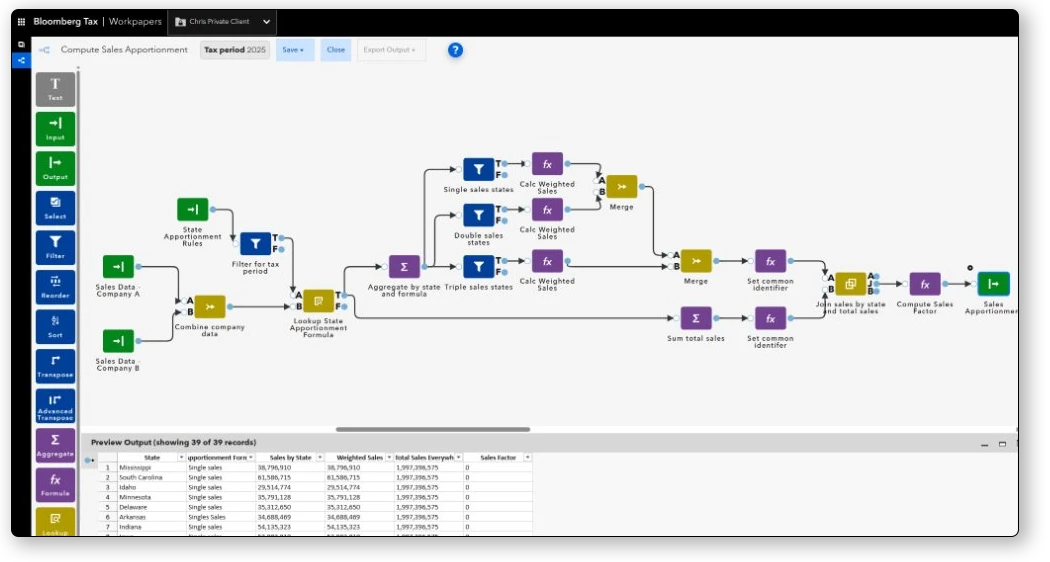
Bloomberg Tax Workpapers’ Data Connect feature allows users to extract, transform, and load data from their ERP or other source systems directly into their tax workpapers.
Using Data Connect, the team built a dynamic process that:
- Filtered invoice transactions based on business logic such as date ranges, dollar thresholds, and exception amounts
- Joined internal data sources with standard system reports to map locations and identify tax-exempt transactions
- Flagged purchases lacking proper sales tax and calculated use tax obligations for direct remittance
- Leveraged the AI Expression Generator to automate calculations, including conditional debit/credit assignments and journal entry value fields
These processes allowed the company to replace its manual Excel-based process with a scalable and repeatable solution.
Results: Improved accuracy, time savings, and greater capacity for higher-value work
The new workflow reduced the time and effort required to prepare monthly indirect tax workpapers. The entire process went from taking eight hours to just 30 minutes – a time savings of about 94% – freeing up more than 90 hours annually thanks to streamlined data ingestions, cleansing, and classification.
The automated workflows also allowed the tax team to expand its invoice review window, capturing more backdated invoices and eliminating previously missed exceptions. As a result, the review process became more focused, and managers could spend less time validating journal entries.
These efficiency gains allowed the team to reallocate resources to other critical areas, including property tax automation and strategic planning.
[Request a demo to see how Bloomberg Tax Workpapers can effectively manage your biggest tax workflow.]