How to Leverage AI for Corporate Tax Success in 2026
Corporate tax teams face a litany of challenges today. Talent shortages, rising compliance demands, and sweeping tax law changes like the US’s One Big Beautiful Bill Act and OECD’s Pillar Two global minimum income tax initiative are creating significant pressure. To address these problems, many departments are turning to artificial intelligence (AI) in tax, to manage workloads, process vast amounts of data, and pursue compliance with greater accuracy.
Amid recruitment and retention struggles, AI has risen in importance for businesses. A recent Bloomberg Tax survey found that three out of four tax departments struggle to attract and retain staff. To help bridge these talent management gaps, a 2025 Gallup report revealed that the percentage of US employees using AI in their roles nearly doubled, from 21% in 2023 to 40% in 2025. For tax professionals, this surge in AI adoption in tax departments underscores the growing need for smarter, more efficient workflows.
However, implementing AI in tax operations requires a thoughtful and strategic approach. To maximize benefits and minimize risks, tax leaders must prioritize solutions that are purpose-built. The right tools are crucial for reducing compliance risks, safeguarding data integrity, and building trust with finance leaders, auditors, and regulators. This article outlines risks to avoid, key attributes of trustworthy AI, strategic focus areas for adoption, and recommended corporate tax AI tools.
[Download the 2026 AI Guide for Corporate Tax Teams report to avoid risks, adopt trustworthy AI, and explore top tools for efficiency and compliance.]
Risks to avoid when implementing AI tax tools
Tax professionals can largely benefit from AI capabilities. However, teams must proceed with caution to mitigate potential risks and ensure responsible adoption.
Inconsistent performance and data quality
AI systems are only as good as the data they are trained on and the materials that they have access to. Generic or “black box” tools with opaque processes or unverifiable outputs can introduce reputational and legal risks, as they may lack the specificity required for complex tax workflows. Incomplete or biased data can lead to inaccurate determinations and serious compliance issues.
Lack of transparency and audit trails
Calculations need to be defensible in tax. AI tools that fail to provide clear audit trails or cite their sources undermine confidence and create compliance risks. When selecting a tool, tax professionals should prioritize solutions that document every step and source to ensure full transparency.
Lax data security and privacy
The confidentiality of sensitive financial data is non-negotiable. When adopting an AI solution, tax professionals must ensure that the product complies with local, national, and international data protection standards. A failure to do so can result in severe penalties and damage client trust.
Hallucination and misinformation
AI models can “hallucinate,” or generate plausible but incorrect information with a high degree of confidence. Relying on such outputs for tax advice can be misleading and dangerous. Human oversight to verify that outputs clearly cite authoritative source material is critical to validate AI-generated information and prevent the spread of misinformation.
Regulatory and ethical concerns
Tax laws are constantly shifting, and AI systems may not always keep pace, leading to outdated or non-compliant advice. A “human-in-the-loop” approach, combined with strong internal governance, is crucial to maintain accountability and navigate these ongoing ethical challenges.
Optimize your workflow with AI Assistant
Bloomberg Tax AI Assistant delivers quick, accurate answers with source access for trusted insights.
What to look for in trustworthy corporate tax AI tools
Accuracy is the foundation of any responsible AI platform. The stakes are too high for guesswork or unreliable outputs. So, what does responsible AI look like in practice? Let’s look at features that define a trustworthy product.
Purpose-driven design for tax workflow challenges
A reliable AI product prioritizes solving real tax workflow issues over offering flashy, trendy features. Look for tools that are intuitive to use and directly address key tax challenges, such as finding credible research, keeping up with evolving laws and regulations, or minimizing time spent on repetitive tasks.
Integration with authoritative tax content
Accuracy is essential in tax work, so choose a product that integrates seamlessly with authoritative sources, such as the Internal Revenue Code, IRS guidance, and international treaties. This ensures tax professionals avoid hallucinations, maintain precision, and work efficiently within a single platform, eliminating the need to toggle between multiple tools.
Explainable and transparent outputs
Human oversight remains mission critical when using AI in tax. Look for a product that documents where and how generative AI is applied, the sources it references, and the validation processes it follows to ensure accuracy and reliability.
Seamless alignment with existing tax workflows
AI technology should simplify processes, not complicate them. Choose a platform that integrates effortlessly with current workflows, enhancing efficiency without introducing unnecessary confusion or disruption.
[Get the 2026 AI Guide for Corporate Tax Teams report to mitigate risks, implement reliable AI, and enhance efficiency.]
Strategic focus areas for AI integration in tax
In a high-stakes environment defined by complex tax laws and a shortage of skilled professionals, adopting the right technology has become a necessity. Tax leaders must identify and implement solutions that address specific challenges. Here are a few areas where AI adoption in tax departments adds value.
Tax research
Instead of sifting through volumes of information, tax professionals can use AI to find answers faster, freeing them up for more strategic work. AI tools, such as Bloomberg Tax Answers, can interpret complex queries in plain language, delivering direct answers linked to authoritative sources. In a recent survey, 84% of tax professionals reported finding insights faster with tools like Bloomberg Tax Answers, reducing hours of work into minutes.
Monitoring regulatory changes
As tax laws shapeshift, AI tools help tax teams stay ahead by monitoring regulatory updates and deadlines. Unlike generic AI tools that simply summarize changes, Bloomberg Tax provides context using analyst-vetted news, intelligence, and Portfolios. This enables teams to move from reactive to proactive decision-making.
Automating repetitive tasks
AI-driven tax tools can help with rote, time-consuming tasks like data entry and repetitive calculations. These tools can also simplify complex processes, including preparing workpapers, drafting memos, and managing documentation through advanced automation tailored to tax-specific requirements. By reducing reliance on Excel, which is prone to human error, solutions like Bloomberg Tax improve precision and improve efficiency.
Elevating tax as a strategic function
By handling routine and time-consuming tasks, AI empowers tax professionals to focus on higher-value work. This shift transforms tax teams from compliance-driven roles into strategic business partners capable of driving impactful decisions.
Streamline your corporate tax needs
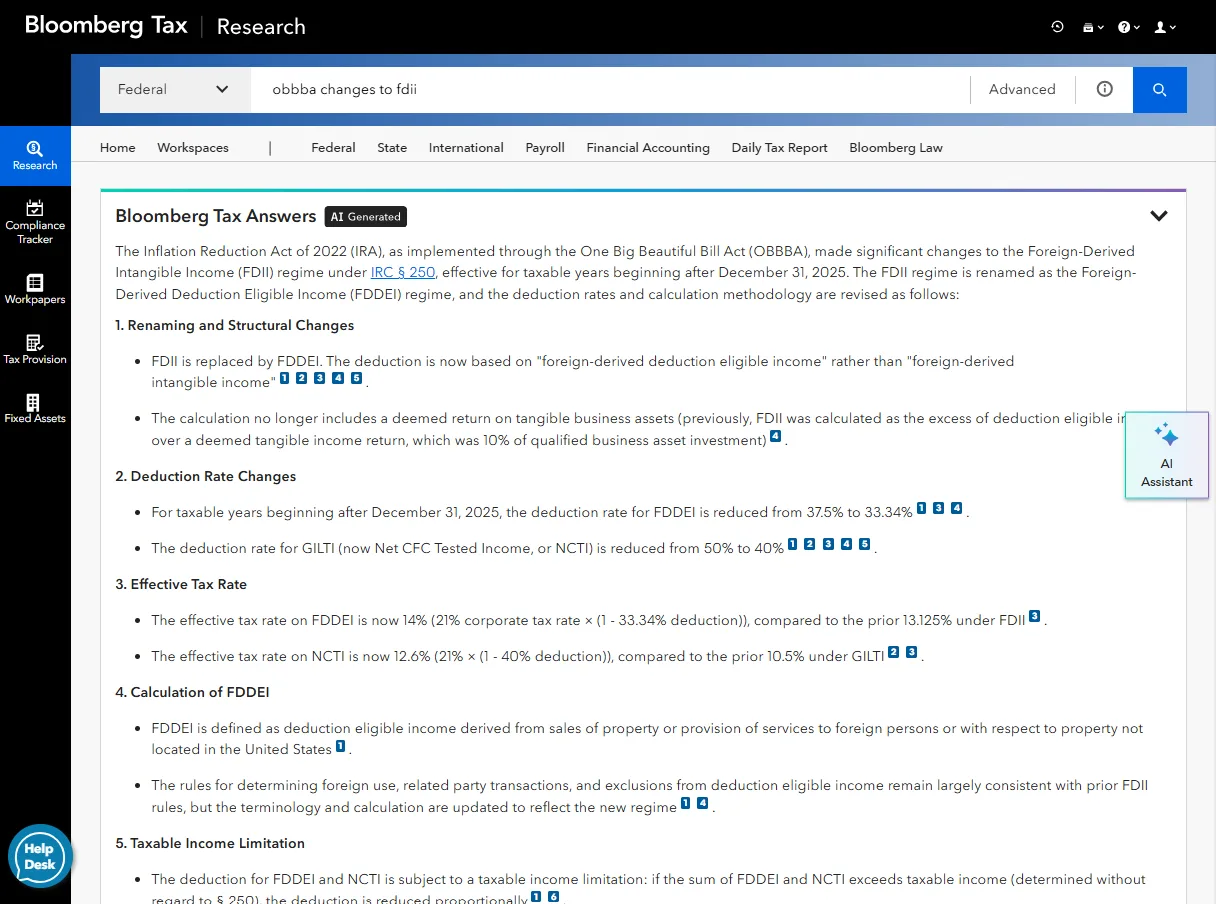
Get fast, summarized tax insights with Bloomberg Tax Answers – straightforward questions, instant summaries, and links to primary sources.
How Bloomberg Tax supports responsible AI adoption
Since 1929, Bloomberg Tax has been a pioneer in innovation and tax information delivery, offering trusted access to news, expert insights, and tools that empower tax professionals to turn knowledge into action. Today, 87% of the top 100 accounting firms and 81% of Fortune 500 companies rely on Bloomberg Tax.
Here’s how Bloomberg Tax is helping professionals implement responsible AI for tax professionals:
1. Tools that minimize disruption
Adopting new technology can be disruptive, costly, and time-consuming. That’s why Bloomberg Tax focuses on creating AI-enabled tools that seamlessly integrate into existing workflows, requiring minimal change management. These tools are designed to solve real-world challenges while reducing friction, enabling easy onboarding, and ensuring a smooth, incremental transition to AI adoption.
2. Risk mitigation through primary sourcing
AI is powerful but not infallible. Recognizing the risks of hallucinations and inaccuracies, Bloomberg Tax grounds its AI tools in primary sourcing. Every tool is rigorously beta-tested and built on a foundation of carefully vetted content, including agency guidance, determination documents, and over 500 practitioner-written Tax Management Portfolios.
Unlike generic AI, Bloomberg Tax’s tools don’t generate answers independently. Instead, they ensure accuracy by drawing from expert-vetted materials. If no reliable content exists on a topic or if a query falls outside the tax scope, the system refrains from providing an answer, so tax professionals can trust its outputs.
3. Built-in citations and research transparency
Transparency is key for building trust in AI. Bloomberg Tax has spent over a decade applying machine learning and natural language processing to create solutions tailored to the tax industry. Every AI-generated response includes clear citations, links to source material, or explanations for why specific results were returned.
For example, tools that suggest related content based on machine learning always indicate the reasoning behind the suggestion. This commitment to transparency ensures users never have to guess the source or validity of the information provided.
4. Purpose-built for regulated environments
Tax professionals operate in highly regulated environments, and Bloomberg Tax designs its tools to meet these unique demands. By transforming tax workflows, these tools help professionals avoid costly human errors, uncover valuable insights across millions of documents, and work more efficiently and strategically.
Bloomberg Tax tools adhere to the highest industry standards for security, including data encryption, two-factor authentication, role-based access, automated data protection protocols, and comprehensive audit controls. This ensures that sensitive data remains protected while enabling professionals to work with confidence.
5. Enhanced audit defense
Confidence in calculations and decisions is critical for tax professionals, especially during audits. Bloomberg Tax tools, like Bloomberg Tax Provision, leverage AI to automate complex processes such as tax provision calculations and ASC 740 compliance.
These tools provide a complete audit trail, recording every change throughout the provision’s lifecycle. Multiple users can collaborate on tax provisions with features like audit trails, sign-offs, and provision locks, ensuring accuracy and defensibility.
Empowering tax professionals with responsible AI
At Bloomberg Tax, our commitment to responsible AI adoption empowers tax professionals to advance their tax strategy with confidence.
Built on decades of innovation, transparency, security, and seamless integration, our AI for tax professionals supports every aspect of corporate tax strategy, streamlining workflows, mitigating risks, automating processes, and ensuring ongoing compliance with expert-vetted insights.
Ready to transform your work? Request a demo today to experience how Bloomberg Tax combines innovation, efficiency, and trust to support AI for tax professionals.