Build a Tax Function That Scales With the Business
Key takeaways
- Scaling efficiently requires replacing spreadsheet-based workflows with automated, connected systems.
- Integrated tax technology expands capacity, reduces errors, and enables the tax function to support growth.
- Automated workpaper rollforwards and reusable data workflows eliminate manual updates and reduce time spent on repetitive tasks.
- Direct ERP integration and automated data transfers remove manual data gathering, improving speed and data accuracy.
Business growth, whether organic or through acquisition, creates a corresponding expansion in tax complexity. Each new legal entity introduces filing obligations, depreciation schedules, intercompany transactions, and provision calculations. Each new jurisdiction adds compliance requirements, rate schedules, and apportionment rules. Each acquisition involves a new fixed asset register and updates to provision calculations.
Those demands don’t scale linearly with headcount. And they don’t have to if the tax function has the right tools. Difficulty arises when departments continue to rely on manual, Excel-based processes that cannot handle increased volume.
At the same time, these outdated systems are making it harder to keep pace, increasing both audit risk and the difficulty of translating legislative change into accurate, timely calculations.
This article focuses on one of the most immediate pressures: how to scale the tax function without scaling headcount.
To read more about how corporate tax leaders can rise to the occasion, download From Pressure to Performance: How Modern Tax Leaders Solve Three Defining Challenges.
The frustration: Where scaling breaks first
The failure points are predictable when manual tax workflows rub up against the demands of growth:
Workpaper rollforwards
Updating prior-period workpapers line by line is labor-intensive under any circumstances. As the entity count grows, the process consumes a disproportionate share of staff time and compounds the risk of error.
Data gathering from source systems
Aggregating trial balance data and other inputs requires extensive manual coordination without direct ERP connectivity. The process is slow and inherently unreliable.
Provision reconciliations
Spreadsheet-based provision models are increasingly difficult to maintain as jurisdictions and entities multiply. Workbooks that function reliably at a smaller scale require substantial rework every time the organizational structure changes.
Fixed asset management
Importing and processing fixed asset data following an acquisition or a significant capital investment cycle requires extensive manual work to align source data with depreciation calculations. Identifying discrepancies and reconciling fixed asset schedules to the general ledger takes time the tax team doesn’t have.
Compliance tracking
Manually collecting and verifying filing deadlines across multiple entities and jurisdictions consumes an average of 40 hours every quarter for large organizations. As the entity footprint grows, so does the compliance burden.
The hidden cost of growth is the mounting operational drag from workflows not designed for enterprise-level complexity.
Get the full picture of how tax leaders are modernizing their operating models – read the complete report.
The solution: Building a scalable tax function through intelligent automation
The Bloomberg Tax Suite of Solutions addresses the scaling challenge with a unified ecosystem of integrated tools that eliminate manual intervention at key points in the tax workflow.
Workpapers: From manual labor to automated intelligence
Bloomberg Tax Workpapers transforms the workpaper process with several interconnected automation capabilities. Automated rollforward eliminates line-by-line updates. With a single action, the system creates a new period workpaper, updates data connections, resets sign-offs, and generates a summary of all changes.
Reusable data transformation workflows allow tax teams to define data cleansing and preparation logic once and apply it consistently each period without recreating these steps when source data changes.
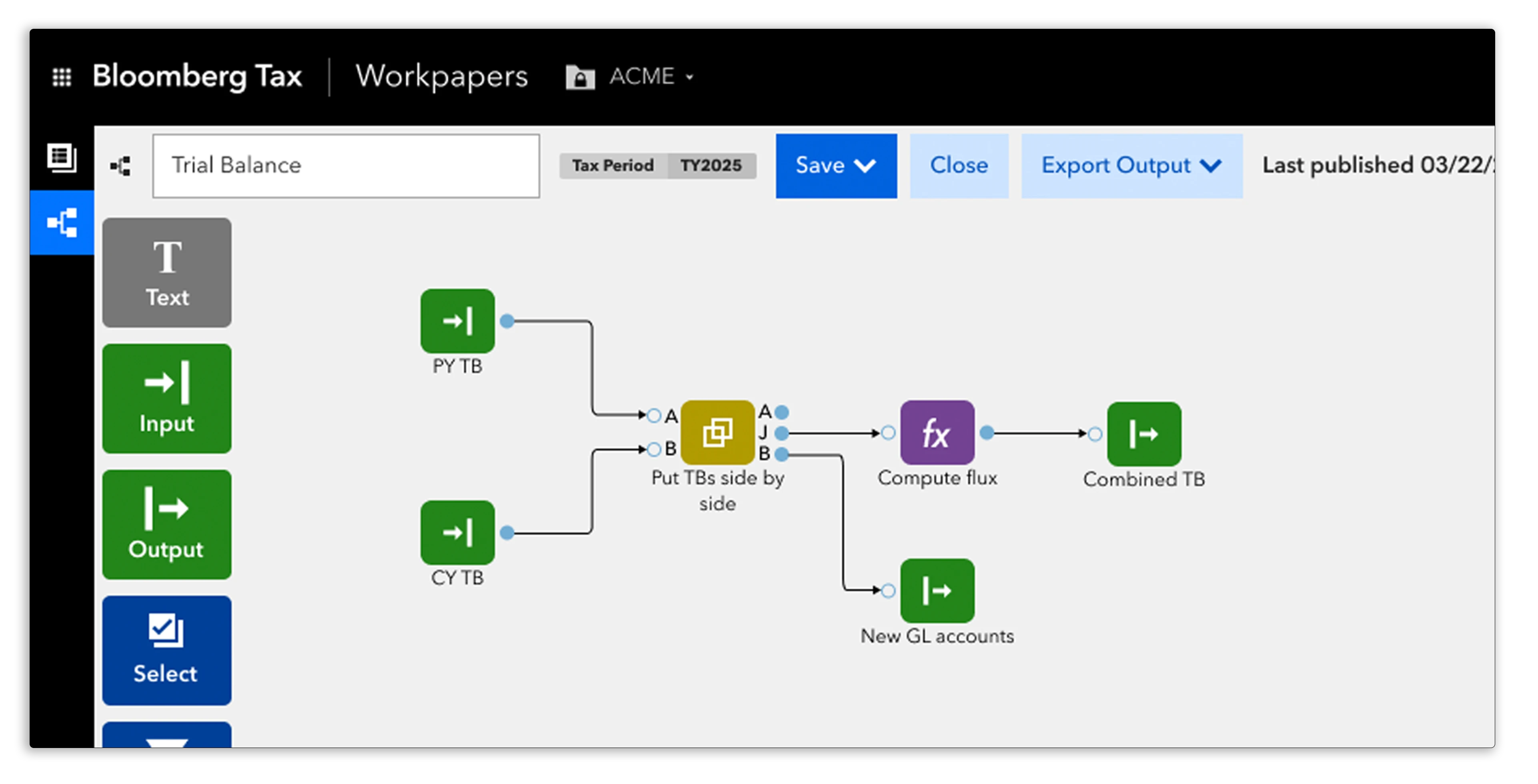
With Bloomberg Tax Workpapers, you can automate data processes unique to tax professionals, including trial balance cleansing, M-1 flux analyses, and period-over-period reconciliations.
Direct ERP integration automates importing data from the trial balance and general ledger, eliminating the manual extraction and re-entry steps that create delays and data integrity risks. Integration with Bloomberg Tax Provision supports direct transfer of final figures to the provision calculation, removing the copy-paste step that introduces errors at the close.
AI-powered enhancements extend these capabilities. Data Connect Instructions Generator allows users to describe a desired workflow in plain language and receive step-by-step build instructions, no technical expertise required.
Workpapers Development Tracker Agent scans the workpaper content to uncover relevant tax law developments and enables follow-up questions within the workpaper environment, reducing time spent manually monitoring for regulatory changes.
Fixed Assets: Automating the asset lifecycle
Bloomberg Tax Fixed Assets’ ability to integrate directly with ERPs and automated transaction mapping transforms ERP data into depreciation calculations. Discrepancy identification capabilities highlight variances between the fixed asset register and the general ledger, so tax teams can reconcile them without manual comparison.
Scheduled reporting produces executive-ready outputs automatically, replacing manual report generation with configurable, time-stamped deliverables.
The solution supports unlimited companies and customizable books, so organizations can scale fixed asset management without system constraints. Cloud-native architecture allows high-volume asset imports following acquisitions or major capital expenditure cycles without degrading performance.
Provision: Designed to scale with complex global businesses
Bloomberg Tax Provision addresses the specific pressures a scaling business puts on the tax provision process, such as increased volume and velocity of tax changes, rising expectations for speed and responsiveness, and difficulty ensuring accuracy under pressure.
With an interconnected data model that automatically propagates changes across the calculation when business facts change, tax teams can go from simply understanding tax rules to easily implementing them across their entire provision process.
Adding new entities or jurisdictions is handled through the system’s integrated architecture without formula reconstruction or workbook restructuring.
Automated return-to-provision true-up calculations eliminate a process that has historically required extensive manual effort. The system’s rapid implementation timeline (measured in weeks rather than months) helps tax departments get up and running quickly.
Research: Compliance automation at scale
Bloomberg Tax’s Compliance Tracker, a workflow feature of Bloomberg Tax Research, automates collecting compliance forms and filing deadlines across all entities and jurisdictions.
Configurable alerts notify the team as deadlines approach or change, with direct links to primary-source citations and official form instructions.
Automatic rollover eliminates the need to rebuild tracking documents each year. The result is a compliance management system that scales with the entity footprint.

Within Bloomberg Tax Research, the Compliance Tracker tool offers automated tracking and gathering of tax forms, filings, and due dates across multiple entities and jurisdictions.
Dive deeper into the strategies transforming the tax function – access the full report: From Pressure to Performance: How Modern Tax Leaders Solve Three Defining Challenges.
AI-powered efficiency and confidence at scale
Artificial intelligence is rapidly becoming essential for corporate tax teams facing talent shortages, rising compliance demands, and increasing regulatory complexity.
AI tools built for tax help departments manage workloads, process large volumes of data, and improve accuracy – enabling tax professionals to move faster while maintaining control.
Used effectively, AI delivers measurable benefits across the tax function. It accelerates research by allowing professionals to ask complex questions in plain language and receive answers linked to authoritative sources, reducing hours of manual effort into minutes.
It also supports continuous monitoring of regulatory changes, helping teams stay ahead of evolving laws and deadlines rather than reacting after the fact.
However, not all AI tools are built for the demands of tax. Generic or “black box” solutions can introduce risk through unverifiable outputs, weak audit trails, and lack of integration with authoritative tax content.
In a function where accuracy, transparency, and defensibility are critical, purpose-built AI is essential.
Bloomberg Tax’s AI capabilities are designed specifically for corporate tax workflows. By combining AI with authoritative content, transparent sourcing, and seamless integration into existing processes, the Bloomberg Tax suite enables teams to increase efficiency while maintaining confidence in every calculation and conclusion.
Ask Bloomberg Tax’s AI Assistant questions in everyday language and get clear, complete responses with links to relevant resources from our library of trusted content.
The outcome: From operational burden to strategic leverage
The operational outcomes are measurable when organizations address the scaling challenge with intelligent automation. Close cycles shorten as automated workflows replace manual steps.
Tax teams’ capacity expands as they redirect time previously spent on data gathering and compliance tracking to higher-value analytical work. Adding new entities or jurisdictions is a manageable operational exercise rather than a trigger for staff overtime.
For tax leaders, demonstrating measurable efficiency gains, including faster closes and fewer errors, translates directly into credibility with finance leadership and the audit committee.
The tax function becomes capable of growing with the business rather than serving as a constraint on its ambitions.
Discover how leading tax teams are scaling efficiently – request a demo of Bloomberg Tax’s integrated suite of solutions.
Transforming tax into a growth enabler
Scaling the tax function no longer requires scaling headcount – but it does require a fundamental shift in how the work gets done. As complexity increases, manual processes and disconnected systems become a constraint on growth rather than a support for it.
The Bloomberg Tax Suite of Solutions provides a unified, integrated ecosystem designed to eliminate that constraint. By connecting workpapers, provision, fixed assets, and research within a single platform, it replaces manual intervention with automated, governed workflows that scale with the business.
Data flows seamlessly from source systems through calculation and compliance, reducing errors, accelerating close cycles, and freeing tax teams to focus on higher-value work.
For organizations navigating growth, this approach transforms the tax function from an operational bottleneck into a scalable, strategic capability.
Request a demo of Bloomberg Tax’s Suite of Solutions to get started.