Turning Tax Complexity Into Consistent, Compliant Processes
Key takeaways
- AI-powered research tools provide real-time access to authoritative tax content with transparent citations, reducing time spent on manual research.
- Embedded tax law updates automatically adjust rates and calculations across workpapers and provision models, eliminating manual rework.
- Interconnected tools ensure data changes flow across all entities and jurisdictions without updating formulas individually.
- Scenario modeling and automated depreciation tools enable tax teams to evaluate decisions and apply changes consistently across the organization.
Tax law is in constant motion. Federal legislation, state rate changes, apportionment updates, and conformity shifts require ongoing monitoring across dozens of jurisdictions.
For companies operating internationally, global minimum tax frameworks and complex jurisdictional rules add new layers of compliance and provision complexity.
ASC 740 requires the financial statement to reflect the impact of enacted tax law changes in the period of enactment. This creates a direct link between legislative activity and provision calculation timeliness. Missing or delaying updates introduces material misstatement and audit risk.
The challenge for most tax departments is not awareness – it’s execution. Translating a continuous stream of change into accurate calculations and defensible guidance strains already limited time and resources.
At the same time, manual workflows and disconnected systems make it difficult to scale operations without additional head count and maintain audit-ready controls.
This article focuses on a critical challenge: how tax teams can move from simply understanding change to effectively implementing it across their processes.
To read more about how corporate tax leaders can rise to the occasion, download From Pressure to Performance: How Modern Tax Leaders Solve Three Defining Challenges.
The frustration: The distance between research and execution
Traditional tax workflows treat research and calculation as separate activities. A tax professional identifies a legislative change, reads the relevant analysis and source materials, determines the applicable rate or methodology, and then manually translates that determination into workpaper formulas, provision models, or fixed asset calculations.
This translation step is where delays and errors tend to occur.
Every legislative change requires manual intervention when research and calculation systems aren’t connected. Tax professionals must update rates and formulas and recheck calculations across every affected entity. Missing rate or law updates due to staff turnover, time pressure, or the sheer volume of changes may not be discovered until the audit. At that point, the remediation cost is much higher than it would have been at the point of initial incorporation.
Compliance monitoring compounds this challenge. Tracking filing deadlines and form requirements across a multi-entity, multi-jurisdictional organization without automation is labor-intensive and creates risk that the company will miss an obligation or deadline.
Dive deeper into the strategies transforming the tax function – access the full report, From Pressure to Performance: How Modern Tax Leaders Solve Three Defining Challenges.
The solution: Intelligence connected to execution
Closing the gap between understanding tax law and applying it requires more than better research – it requires connected systems that bring intelligence directly into the workflow.
By linking authoritative content with calculation and compliance processes, tax teams can move from manual interpretation and updates to automated, real-time execution.
Here’s how integrated tools enable tax professionals to incorporate change accurately, consistently, and at scale.
Research: AI-powered, authoritative, integrated
Bloomberg Tax Research provides tax professionals with access to authoritative primary source materials, including the Internal Revenue Code, Treasury regulations, IRS rulings, and federal and state court decisions, alongside expert analysis from the world’s leading tax specialists.
A combination of primary sources and expert guidance, updated in real time, helps tax professionals identify and assess the implications of regulatory changes as they occur.
The AI Assistant extends these capabilities through an intelligent, context-aware research interface. Drawing exclusively on verified Bloomberg Tax content rather than synthesized summaries of uncertain provenance, the AI Assistant lets users ask complex, multi-part tax questions and receive responses grounded in authoritative source materials, with transparent citations so users can verify and defend every position.
Deep Thinking Mode, a capability designed for the most complex and research-intensive questions, asks clarifying follow-up questions to ensure the system fully addresses multi-step queries before generating a response. It then produces comprehensive research reports on nuanced issues.
Ask Bloomberg Tax’s AI Assistant questions in everyday language and get clear, complete responses with links to relevant resources from our library of trusted content.
The AI Assistant is also integrated directly into Bloomberg Tax’s Compliance Tracker workflow so users can ask compliance-related questions within the tracking environment and receive answers drawn from authoritative research content without leaving the workflow.
Our AI capabilities are built on a foundation of authoritative content and expert analysis, so AI-assisted research and automation augment professional judgment rather than create new categories of risk.
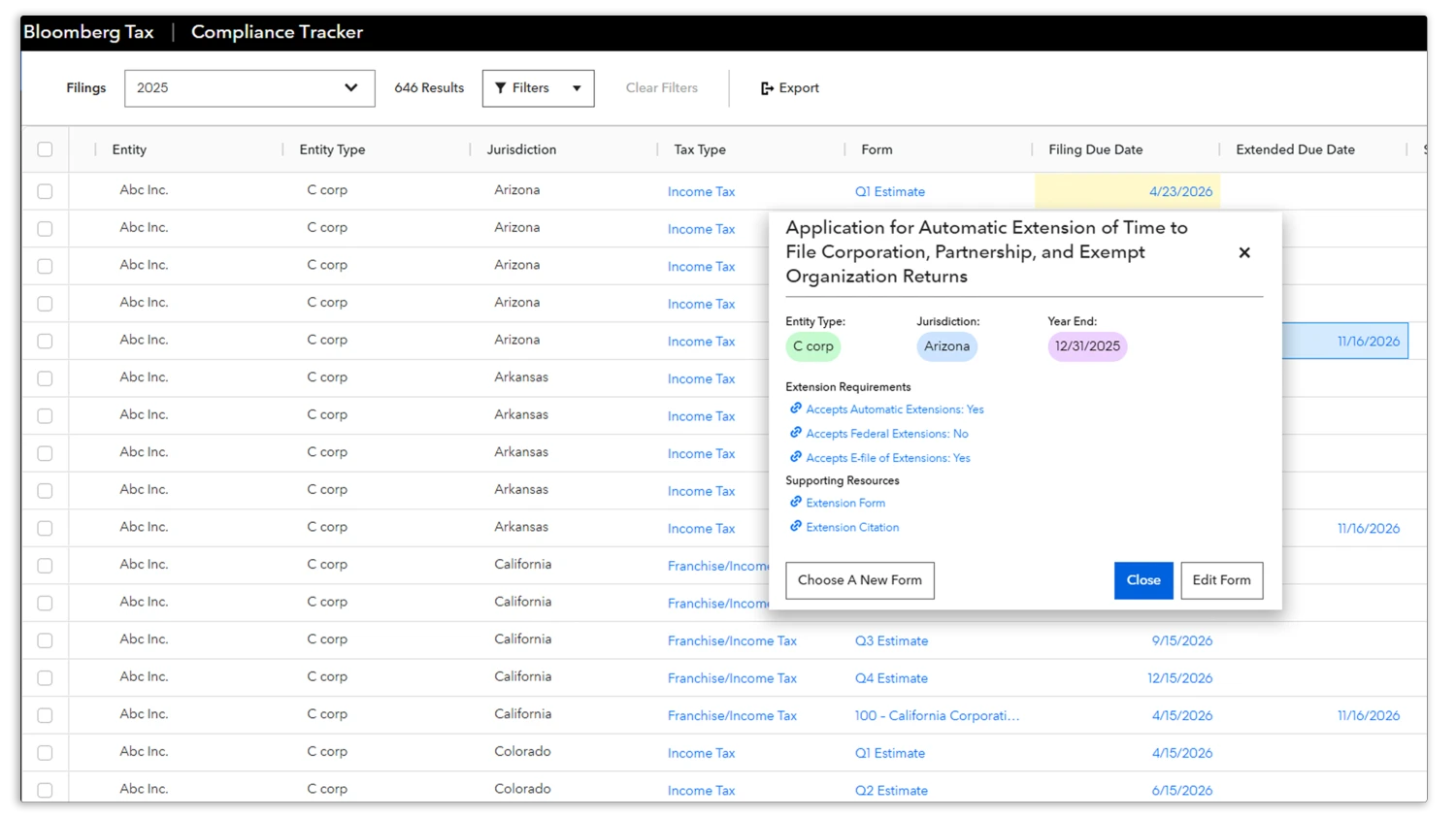
Within Bloomberg Tax Research, the Compliance Tracker tool offers automated tracking and gathering of tax forms, filings, and due dates across multiple entities and jurisdictions.
Workpapers: Updated tax law embedded in calculations
With Bloomberg Tax Workpapers, teams no longer need to stop their work to search for guidance, validate assumptions, or chase down the latest tax law changes. Instead, authoritative Bloomberg Tax Research is embedded directly into the workpapers experience, supporting decisions at the moment they are made.
Custom tax functions within workpapers draw current rate and law values directly from expert-verified Bloomberg Tax Research content.
It automatically updates state tax rates, apportionment weighting factors, and international tax rates embedded in calculation templates when underlying law changes without requiring manual identification and re-entry of updated values.
When a question arises during workpaper preparation, the user can access AI-generated responses drawn from Bloomberg Tax content without leaving the calculation. Embedded citations to primary sources within the workpapers provide a documentation trail to support internal review and external audit.
And the Developments Tracker Agent uses AI to surface legislative developments that impact your workpaper and provide linked citations so you can validate the source law.
See how to keep your calculations up to date with the latest rates and rules from Bloomberg Tax Research embedded in your spreadsheets.
Provision: A calculation model that adapts in real time
Bloomberg Tax Provision’s interconnected data model automatically updates provision calculations when business facts change due to legislative rate changes, the addition of a new jurisdiction, or a material transaction.
This feature eliminates the manual step of identifying every affected formula or calculation and updating each one individually, a process that is time-consuming and error-prone.
The system supports jurisdiction-based tax-effecting and seamlessly accommodates non-U.S. statutory rates for global compliance and reporting, so organizations with international operations maintain accurate provisions across their jurisdictional footprint.
Fixed Assets: Model depreciation decisions without the risk
Bloomberg Tax Fixed Assets allows users to maintain up-to-date depreciation rates automatically, apply changes consistently across entities, and leverage scenario modeling to evaluate different election strategies before making irreversible decisions.
Modeling capabilities also provide the essential depreciation data needed to calculate how different elections will impact taxable income, deferred tax balances, and cash flow under ASC 740 and other reporting requirements.
The ability to run “what-if” analyses, compare outcomes, and assess long-term impacts is becoming essential as tax leaders balance immediate deductions with broader financial and regulatory considerations.
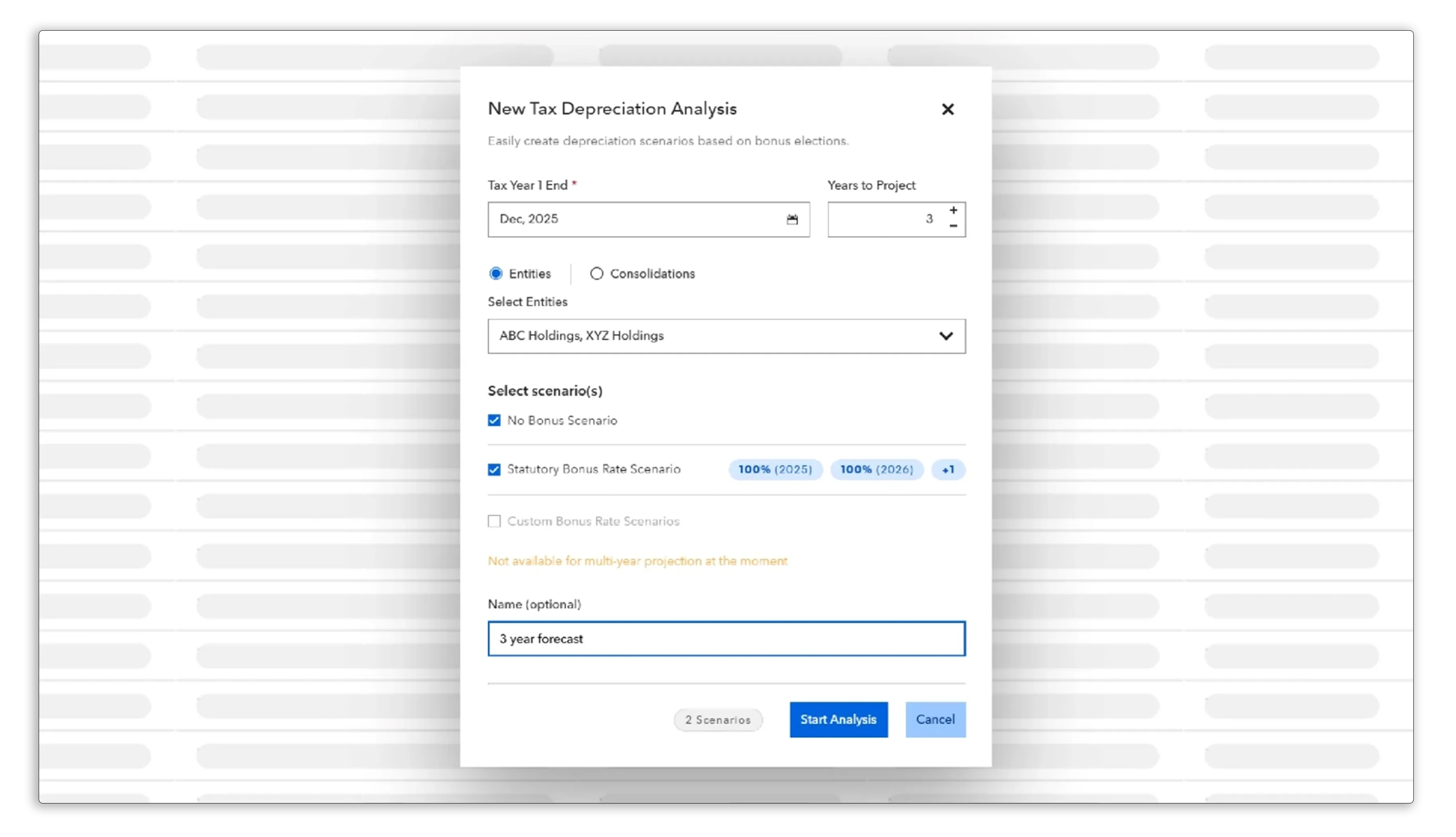
Project depreciation for a single tax year or up to 20 years with Bloomberg Tax Fixed Assets to understand both immediate and future impacts on taxable income and cash flow.
Move from interpreting change to implementing it with confidence – book a demo of Bloomberg Tax’s integrated suite.
The outcome: From reactive compliance to proactive strategy
With connected research and execution tools, tax professionals have greater capacity to respond to external change. They can promptly identify legislative and regulatory changes, assess the operational implications, and incorporate their impact into calculations.
The director-level outcome is a function that advises the business on the implications of tax changes rather than simply responding to them. Quickly translating new laws into accurate calculations reduces the risk of misstatement. Transparent research conclusions in provisions and workpapers strengthen communication with corporate leaders and external auditors.
Moving from reactive compliance to proactive strategy is what defines a modern, high-performing tax function.
See how you can turn tax law changes into real-time action – request a demo of the Bloomberg Tax Suite of Solutions.