How Casella Transformed a Multi-day Tax Process Into a One-Day Workflow with Greater Efficiency and Control
Casella Waste Systems, Inc. is a leading waste management company operating primarily in New England and mid-Atlantic states while delivering wide-ranging waste and recycling solutions to customers in the contiguous United States. Casella faced significant challenges with highly manual tax processes, collaboration challenges, and compliance risks when managing their quarterly tax provisions in Excel.
By implementing Bloomberg Tax’s integrated suite of Provision, Research, and Workpapers products, Casella’s tax team achieved remarkable improvements in efficiency and has been able to reallocate team resources to more strategic initiatives.
Key outcomes include:
- Time savings from automated data cleansing
- Accurate and efficient calculation workflows
- Enhanced collaboration and controls
- Streamlined rollover processes from quarter to quarter
Challenge: Manual tax processes and growing complexity left the team buried in busywork
Casella Waste Systems operates as a comprehensive waste management company with diverse operations including waste hauling, recycling, and organics processing.
With a presence across most of the United States, Casella’s tax department manages complex tax obligations across multiple jurisdictions.
Prior to implementing Bloomberg Tax solutions, Casella’s tax team faced several critical challenges that threatened both efficiency and compliance.
“Highly manual processes, collaboration issues, and audit and compliance risk were the main drivers of why we decided to look for a software to help us with our provision process,” said Rebecca Adams, senior tax manager for direct tax at Casella.
“When you’re trying to manage a very large Excel document for all these changes, it takes away from the value of things like planning, analysis of what’s going on and other tasks,” Adams said.
The team’s biggest challenges included:
- Highly manual processes: Excel-based workflows created substantial vulnerability to human error and time lost to repetitive tasks like rollforwards, data cleansing, and updating templates with new tax laws.
- Version control and collaboration issues: Excel poses a challenge when multiple users try and share a workbook, often not allowing more than one user to access at a time
- Scalability and complexity challenges: Casella’s multi-state footprint meant tracking numerous taxing jurisdictions, laws, and regulations. And as the business expanded, their Excel-based model became unwieldy.
Solution: Integrating Research, Provision, and Workpapers for seamless efficiency
Casella implemented a comprehensive solution consisting of three integrated Bloomberg Tax products: Research, Provision, and Workpapers.
The team began with Bloomberg Tax Research, establishing a foundation of trusted tax law insights to inform their tax strategies and calculations.
According to Kelly Dolan, senior tax accountant at Casella, the team finds great value in the chart builder functionality, allowing them to compare rules and regulations from state to state as they manage Casella’s large state footprint.
“Also, with all of the new federal legislation coming out, it’s been really helpful to stay up to date with how states are impacted by those changes in legislation and how Bloomberg Tax or other sources are interpreting those new regulations,” Dolan said.
Casella subsequently added Bloomberg Tax Provision, which was appealing due to its user-friendly interface and simple implementation.
“We really liked that there’s a trail of the formulas that are used and it looks very similar to Excel,” Adams added.
Bloomberg Tax Workpapers completed their suite, chosen specifically for its ability to integrate seamlessly with their existing Bloomberg Tax products while also addressing their manual process challenges.
They found particular value in:
- Real-time updates with tax law changes, saving time and reducing manual adjustments
- Customizable templates that fit their specific needs
- Improved collaboration with a better audit trail and sign-off process to accommodate their growing team
The implementation followed a strategic, incremental approach that allowed the team to validate processes while building confidence in the new system.
[See how Bloomberg Tax empowers your team to eliminate manual workflows and focus on high-value analysis – request a demo today.]
Results: Days of work reduced, plus enhanced controls and improved collaboration
The implementation of Bloomberg Tax’s integrated suite transformed Casella’s most time-intensive processes, delivering measurable gains in efficiency and collaboration.
The impact is clear:
- Manual bottlenecks have been replaced by automated workflows
- Data processing time was reduced by as much as a full day, freeing the team to focus on higher-value, strategic work
- Built-in controls and audit trails strengthen compliance and give auditors clearer visibility
- Cloud-based collaboration eliminates version-control headaches
With greater confidence in their data and more time to analyze evolving tax legislation, Casella’s team now operates with greater precision, agility, and peace of mind.
Dramatic time savings
Automating the stock compensation process alone saved the team nearly a full week during their Q2 provision cycle. What used to be days spent manually cleansing data, double-checking calculations, and rolling over templates is now accomplished in significantly less time.
Previously, rolling forward calculations meant painstaking work to clear out old data, update links, and revalidate every step – now, Bloomberg Tax Workpapers does it all with a few uploads and the press of a button.
“I remember at one point during Q2 we all [realized] we have a lot of extra time to do other calculations and analysis because this massive calculation that used to take us pretty much the full week of the provision took us significantly less time,” Dolan said.
[Experience the efficiency gains Bloomberg Tax delivers by automating calculations and improving accuracy. Schedule your tailored demo now.]
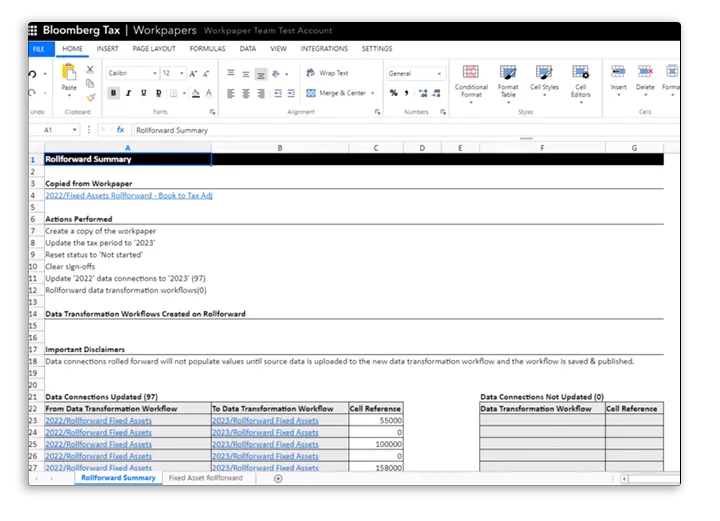
Bloomberg Tax Workpapers takes the manual work out of the rollforward process. With just a few clicks, the values will be automatically updated with the new data source and the new workpaper will provide a summary of everything that was done.
Risk reduction and peace of mind
The shift from Excel to Bloomberg Tax’s automated workflows has significantly reduced the risk of errors.
With built-in checks, standardized templates, and clear audit trails, the team can now ensure all data is captured with far less risk of accidental omissions or formula mistakes.
According to Dolan, “We were able to add in a lot of checks to verify the information agreed to the raw data. That definitely increased our peace of mind.”
Kelly Dolan
Senior tax accountant, Casella Waste Systems
Instead of troubleshooting errors or tracking down inconsistencies, the team now enjoys greater assurance that their work is reasonable and consistent across periods.
Enhanced audit trail and control
Bloomberg Tax Workpapers’ built-in sign-off capabilities and detailed audit trails shorten and simplify the review process. The robust documentation reduces the administrative burden during audits and gives leadership added confidence in the integrity of their tax processes.
“Our external reviewers really enjoyed the output that we were able to download out of the system,” Dolan said. “It was very detailed. It gave all of the calculations and in the workflow broke it out step by step.”
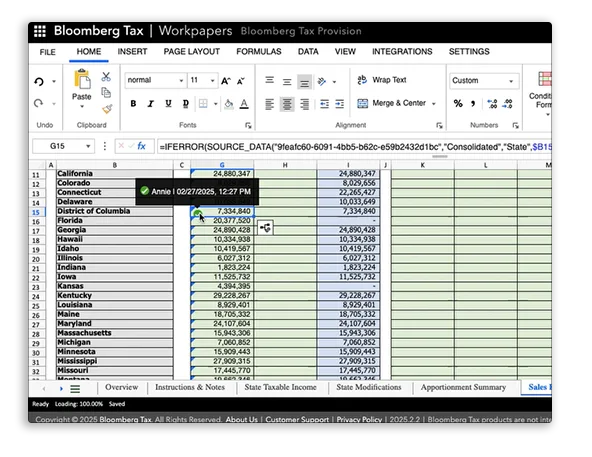
Bloomberg Tax Workpapers eliminates the risk of unintended changes to workpaper calculations with cell-level change tracking and reviews.
Improved collaboration and data integrity
The cloud-based system eliminated the collaboration bottlenecks that plagued their Excel-based processes where only one team member could work on a file at a time. Now, multiple team members can access workpapers without disruption and update calculations simultaneously, with changes saved in real time and documentation of who made the changes.
This improvement has enabled smoother handoffs, faster reviews, and a much more agile workflow, making it easier for the team to respond quickly to new challenges or tight deadlines.
From stress to strategic success
For Adams, the implementation of Bloomberg Tax Workpapers has been a “stress reliever.” Knowing their processes are validated, and efficient gives her confidence heading into year-end.
“I see our year-end going much smoother than it has in the past,” she said. “We have more time to understand why things are happening.”
Rebecca Adams
Senior tax manager, Casella Waste Systems
By embracing technology and taking a strategic, phased approach, Casella Waste Systems has successfully modernized its tax department, proving that the right tools can turn painful processes into major wins.
“Without having to do all the manual processes for stock compensation, we were able to focus on other areas of our provision and really dig into those more tax sensitive and more technical items,” Dolan said.
“During Q2 of this year, there happened to be a lot of federal legislation changes [on the horizon], so we were able to utilize some of that extra time to even do some projections of what our provision calculation might look like once those are implemented at the tail end of 2025.”
Phased implementation approach
Rather than attempting to overhaul their entire process simultaneously, Casella’s tax team adopted a measured approach focused initially on their stock compensation calculation – a complex but self-contained process that served as an ideal pilot project.
The process begins with raw data that the team receives from their stock compensation software, and also involves a manual rollover each quarter.
“Those reports have historically been cleansed manually, so that’s just a lot of work upfront before we can even get to the tax technical calculation.”
The team conducted a parity calculation comparing their Q1 results using both their legacy Excel method and the new Bloomberg Tax Workpapers system.
Bloomberg Tax Workpapers’ data cleansing automation eliminated the manual manipulation of raw stock compensation reports and made the entire process more efficient.
“We’ve historically used draft data to perform the calculation, but now with the data cleansing, we have the time and the ability to wait until we get the finalized data,” Dolan said.
“The incremental approach has ensured that we are keeping our efficiency at every step of the way,” said senior tax accountant Bianca Dawson. “This is also allowing for progressive training of our staff, and it builds confidence and ensures continuity.”
Recommendations for other tax teams
Casella’s team encourages other tax departments to adopt a phased approach when implementing new technology solutions.
Rather than a sweeping change, they recommend:
- Start with a single complex process: Select a challenging but self-contained workflow to pilot the new system. This allows the team to focus on learning, address specific pain points, and generate early results.
- Validate results and build confidence: Run parallel calculations with legacy and new tools to ensure data integrity. This side-by-side validation enables teams to confirm reliability and make adjustments where needed before wider adoption.
- Expand gradually to other workflows: Once confidence is established, identify additional processes – such as those involving large datasets, repetitive backups, or manual data cleansing – that can benefit from automation and integration.
- Prioritize customization and real-time updates: Seek solutions that provide flexibility in designing templates and workflows tailored to your organization’s specific needs. Real-time tax law updates are invaluable for staying compliant and efficient across jurisdictions.
- Foster collaboration and transparency: Choose platforms that facilitate multi-user access, clear audit trails, and robust sign-off processes to enhance team efficiency and accountability, especially as your organization grows.
By following this incremental, validation-oriented approach, tax teams can optimize implementation, minimize disruption, and realize lasting efficiency, compliance, and collaboration gains.
As businesses grow and tax law evolves, relying on Excel models can quickly become unsustainable, making modernization essential.
“It’s never going to get better unless you make a change,” said Dolan. “So you have to sacrifice a little bit of time to gain a lot of time back in the future.”
Ready to give time back to your tax team? Schedule a demo to discover how Bloomberg Tax’s integrated solutions can streamline your workflows and enhance your team’s strategic capabilities.